
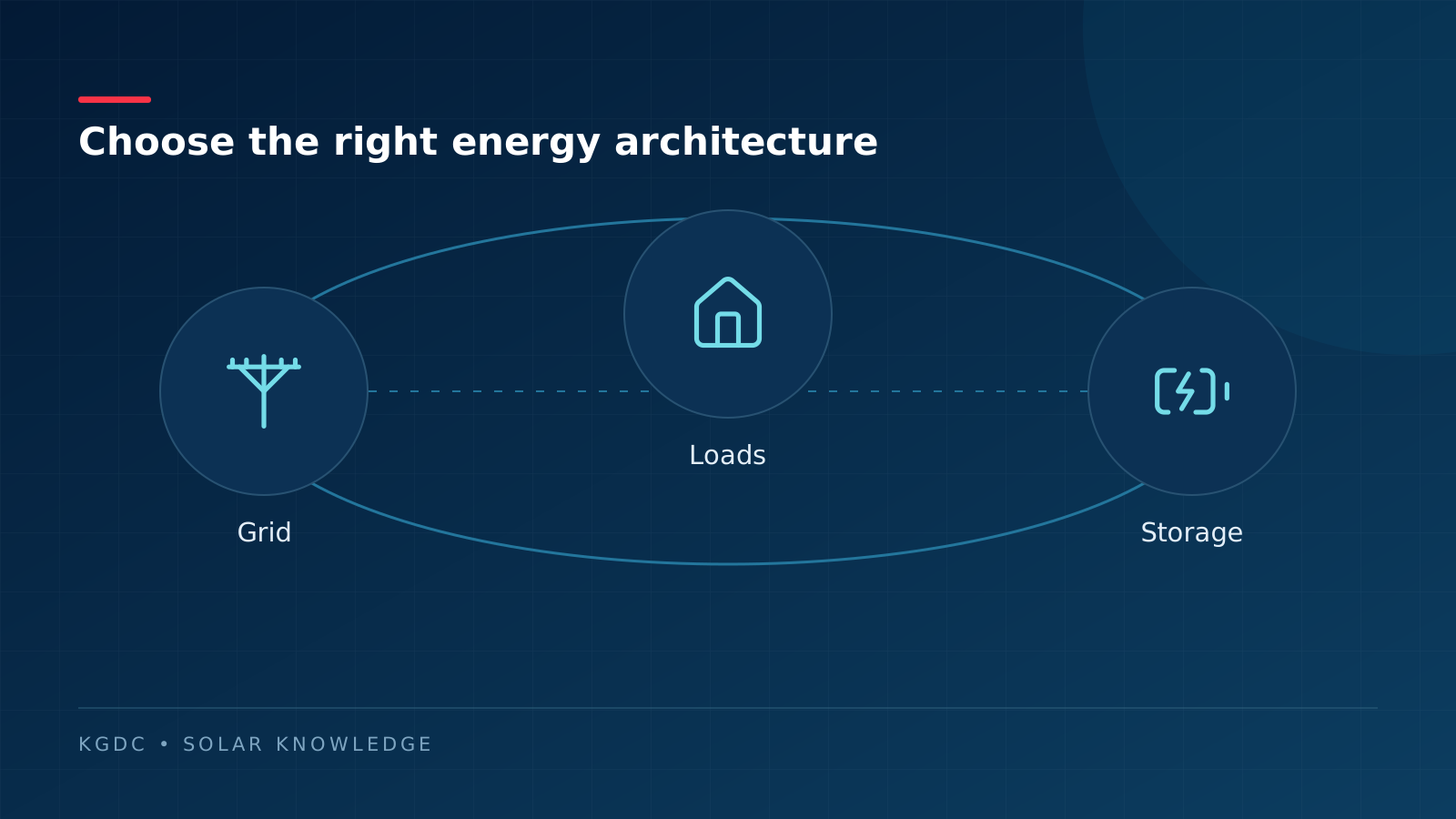

Three situations happen through the day
In the morning or evening, solar may be lower than your load, so the premises imports the balance. Around a sunny low-load period, generation may exceed consumption and surplus can flow out. At other times, solar and demand may be close. The bidirectional meter records import and export separately; it does not physically store electricity for night use.
Your bill may not become zero
Solar usually offsets energy charges associated with eligible units, but fixed charges, demand charges, duties, minimum charges or other billing components can remain. Export credit, carry-forward, settlement period and treatment of surplus are governed by the applicable regulation and utility procedure—not by a universal national promise.
Why on-grid solar stops in a power cut
A standard grid-connected inverter uses anti-islanding protection. When grid supply fails, it disconnects so that solar cannot energise a line that utility personnel may assume is dead. Backup requires a separately designed hybrid or off-grid arrangement with a suitable inverter, battery, isolation and an identified essential-load panel.
What to confirm before signing
Ask for answers tied to your electricity bill and connection.
- Correct DISCOM or electricity licensee and consumer category.
- Sanctioned load or contract demand and the permitted solar capacity.
- Applicable net, gross, virtual or group-net-metering route.
- Feasibility approval, meter responsibility, testing and commissioning steps.
- How imported and exported units are valued, carried forward and settled.
- Whether fixed or demand charges continue and how phase requirements apply.
The usual project journey
A sound sequence is bill review → roof and shadow survey → capacity proposal → utility application and feasibility → engineering and installation → protection testing → bidirectional-meter installation → commissioning and monitoring. Do not treat the meter as a final afterthought; the approval path shapes the project design.
Official references
Regulations, eligibility and utility procedures can change. Verify the current rule and site-specific approval before investment.