
Solar for the electricity your community shares
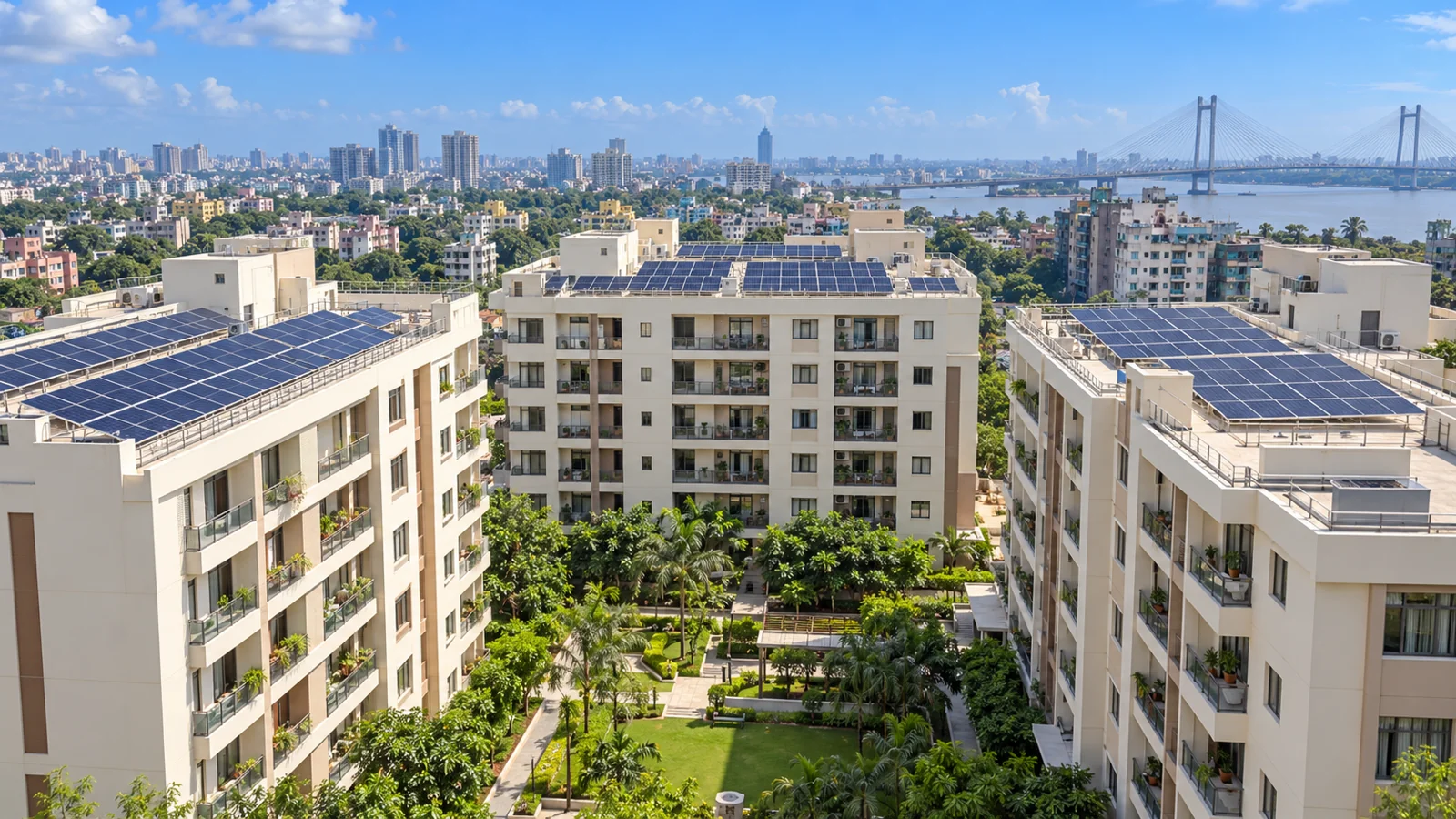
A Group Housing Society (GHS) or Resident Welfare Association (RWA) can plan rooftop solar for common facilities such as lighting, pumps, lifts and eligible EV charging. Size the system against the common-meter energy profile, roof availability and the DISCOM-approved connection arrangement. The eligible GHS/RWA connection must serve common facilities only, rather than supply individual homes. Individual apartment bills and common-area bills are different use cases.
The common-facility subsidy framework
| Item | Standard CFA provision |
|---|---|
| Rate | ₹18,000 per eligible kW |
| Overall capacity ceiling | Up to 500 kW |
| Household-linked ceiling | 3 kW per house, subject to the scheme’s aggregate rules |
| Included use | Common facilities, including EV charging |
The scheme’s capacity limit includes individual rooftop plants installed by residents in the GHS/RWA. Account for these before estimating the remaining eligible common-facility capacity. CFA is subject to actual eligible installation and approval.
Illustration: a society with 100 homes
The household-linked ceiling is 100 × 3 kW = 300 kW, below the 500 kW overall limit. A proposed 100 kW common-facility installation would have an indicative CFA of ₹18 lakh at ₹18,000/kW, provided sufficient eligible capacity remains after accounting for individual installations and all other conditions are satisfied. This is an illustration, not a sanction.
Can a builder or developer claim the subsidy?
Yes, the MNRE clarification dated 19 November 2024 permits CFA under the Group Housing/RWA segment to be provided directly to developers/promoters, subject to an undertaking that the supported rooftop solar asset will be handed over to the residents’ collective when it is formed. A second undertaking must confirm that residents receive the subsidy benefit through reduced charges or tariffs for common facilities. REC may ask for additional supporting documents. This is a conditional residential common-facility route, not a general subsidy for a builder’s commercial premises.
What the builder proposal should document
- The residential project, household count, common electricity connection and the capacity already supported under the scheme.
- The applicant’s authority and the undertaking for handover to the GHS, RWA, apartment owners’ association, cooperative society or other residents’ collective.
- How the subsidy benefit is passed to residents and how ownership, operating responsibility and maintenance will be transferred.
- A design, cost and cash-flow schedule that separates installation payments from expected CFA release.
- Metering, commissioning, electrical safety and supporting documents required by the portal and DISCOM.
Plan now for a useful handover
Reserve safe maintenance access, roof load capacity and routes for cables, earthing and water. Agree who monitors generation, pays for maintenance and manages warranty claims after handover. KGDC can prepare an engineering and commercial proposal for the developer or the residents’ committee.
Official sources
Builder clarification
MNRE clarification dated 19 November 2024: CFA to RWA/GHS cases.